


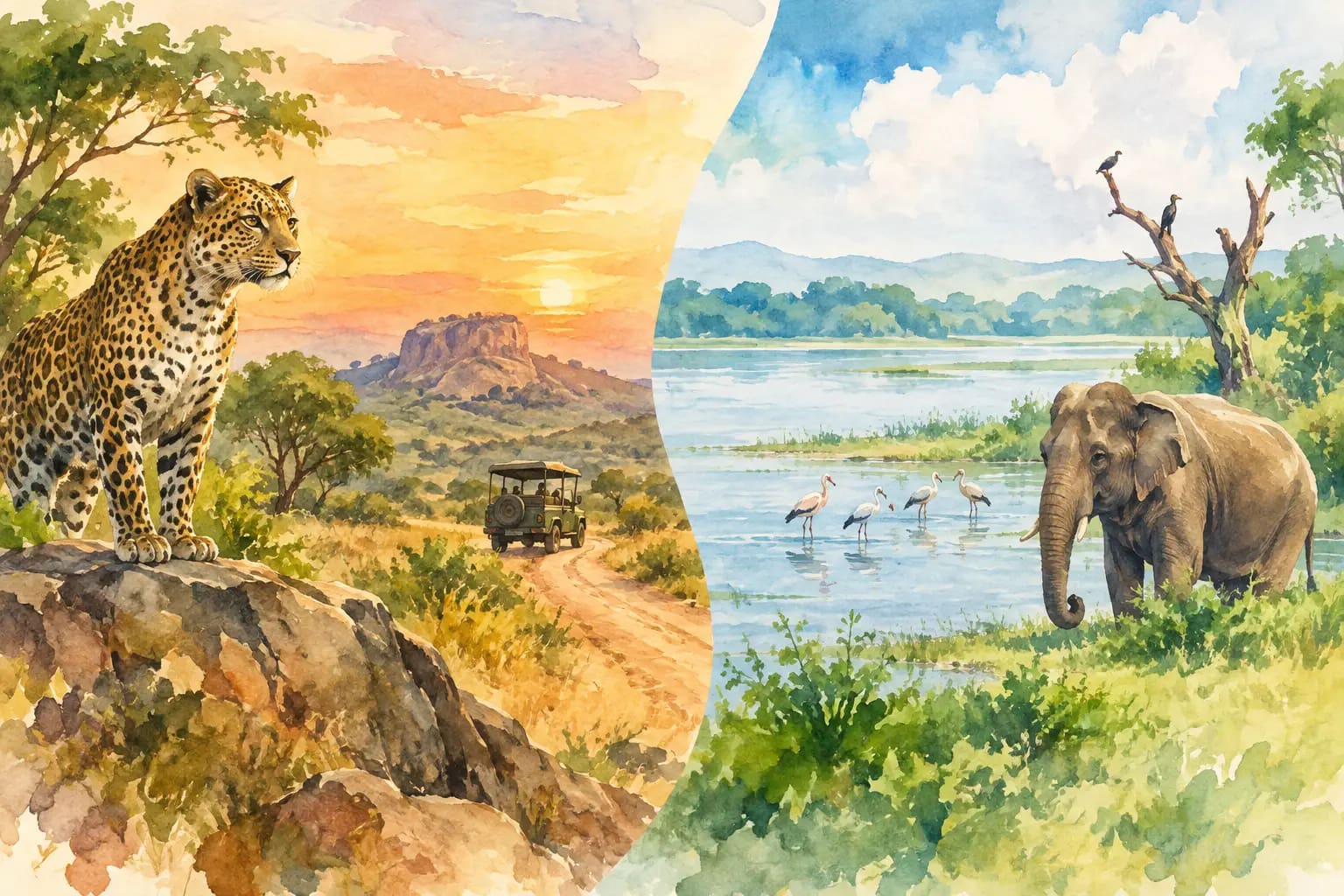
A leopard steps from the scrub, pauses in the amber light, and disappears again before the camera is quite ready. That possibility sits at the heart of a Yala versus Wilpattu safari decision, but it is not the whole story. These are two very different ways to encounter Sri Lanka’s wild side: one is dramatic, celebrated and often wonderfully active; the other is quieter, more spacious and defined by ancient forest and still water.
For a luxury holiday, the best choice is rarely about which park has the better reputation. It is about the rhythm you want your journey to have, where you are travelling from, and whether you would rather prioritise prolific sightings or the rare pleasure of feeling far from everyone else.
Yala versus Wilpattu safari: the essential difference
Yala National Park, in Sri Lanka’s south-east, is the country’s most recognised safari destination. Its Block I is renowned for one of the world’s highest known leopard densities. The landscape feels open and cinematic: dusty tracks, low scrub, grassland, rock outcrops and lagoons create long sightlines, so wildlife encounters can feel immediate and exhilarating.
Wilpattu, on the north-western edge of Sri Lanka’s Cultural Triangle, is altogether more hushed. It is Sri Lanka’s largest national park and is distinguished by its villus – natural, rain-fed lakes scattered through dry-zone forest. A game drive here unfolds through dense woodland, beside glassy waterholes and along sandy trails. Leopards live here too, alongside elephants, sloth bears and deer, but sightings are often earned through patience rather than expected around every bend.
Put simply, choose Yala for a more energetic, high-probability wildlife experience. Choose Wilpattu for immersion, tranquillity and a greater sense of discovery.
For leopard sightings, Yala has the advantage
If seeing a leopard is the non-negotiable wish on your Sri Lanka holiday, Yala is usually the stronger choice. Experienced trackers know the territories, and the open terrain gives guides and guests a better chance of observing an animal at a respectful distance. Leopards may be seen resting in a tree, moving along a track or surveying the plains from a boulder.
That advantage comes with a trade-off. When a leopard is spotted in a popular area, several jeeps can gather quickly. A skilled private guide can help by choosing less congested routes, timing drives carefully and moving on when the moment no longer feels considered. Yet Yala’s popularity is real, particularly in peak travel periods and during busy morning drives.
Wilpattu offers a different kind of leopard encounter. There may be fewer sightings on a single drive, and the forest can make viewing more challenging. But when a leopard walks quietly through the trees or appears beside a villu with no cluster of vehicles nearby, the experience can feel deeply personal. For guests who value the atmosphere of the search as much as the photograph, Wilpattu can be exceptional.
The wildlife beyond the leopard
Both parks reward travellers who look beyond one iconic animal. At Yala, elephants are frequently seen, particularly around water and open plains. Mugger crocodiles, spotted deer, sambar, wild boar, jackals, peacocks and an impressive range of birdlife create a constantly changing scene. The park is also one of the better places to look for the elusive sloth bear, especially when palu fruit is in season, typically around May to July.
Wilpattu’s waterholes draw their own quiet drama. Elephants may emerge from the forest to drink, while painted storks, eagles and kingfishers animate the lake edges. Deer move through the shade in small groups, and sloth bears are present, though never guaranteed. The woodland setting gives every sighting a more intimate frame, even when the animal is not rare.
Neither park should be approached as a wildlife checklist. Nature does not perform to a timetable, and even the finest guide cannot promise a particular sighting. The luxury lies in allowing enough time, travelling with an expert naturalist, and enjoying the landscape between encounters.
Crowds, pace and the feel of each game drive
Yala is ideal for travellers happy to trade some solitude for a livelier safari. At first light, its tracks can be busy, especially near well-known leopard territories. This does not mean every drive feels crowded, but it does mean that park strategy matters. Staying close to the entrance, departing promptly and choosing a lodge team with strong local knowledge can make a meaningful difference.
Wilpattu is better suited to those who find luxury in space. Drives can feel wonderfully unhurried, with long stretches where the loudest sound is the call of a junglefowl or the tyres passing over dry leaves. The park’s vast scale and lower vehicle density lend themselves to reflective, slower-paced exploration.
Families often enjoy Yala’s near-constant sense of possibility, particularly for a first safari. Honeymooners and couples seeking a more secluded wilderness interlude may prefer Wilpattu. That said, a family with older children who are patient observers may find Wilpattu far more memorable than a busier park. The right answer depends on temperament, not simply travel party.
Which park fits your Sri Lanka itinerary?
Yala combines naturally with Sri Lanka’s southern coast, tea country and Galle. After days in the hill country or by the Indian Ocean, a two-night stay near the park brings a thrilling change of scenery. It works especially well in a journey that balances culture, wildlife and a final beach retreat.
Wilpattu sits more comfortably within an itinerary that includes Anuradhapura, Sigiriya, Dambulla or the east coast. It is an elegant addition after exploring the Cultural Triangle’s temples and ancient cities, replacing a long transfer south with a gentler transition into the wild. For travellers who want to experience Sri Lanka beyond its most familiar route, Wilpattu feels particularly rewarding.
Two nights is the minimum we would recommend at either park, allowing for at least three game drives without turning the stay into a race. Three nights suits keen photographers, wildlife enthusiasts and anyone who wants a restorative lodge experience alongside safari time. A single night can work on a tightly paced itinerary, but it leaves little room for weather, park conditions or the simple unpredictability that makes wildlife special.
When should you go?
Yala’s most popular section generally closes for a period each year, often around September and October, to allow the landscape to recover. Exact dates can change, so a carefully planned itinerary should always confirm the current park schedule. The drier months tend to make wildlife easier to spot around water sources, though Yala remains a compelling destination for much of the year.
Wilpattu is also affected by seasonal rain, particularly during the north-east monsoon months. Conditions vary by year, and tracks may be slower after rainfall. In return, the forest can be vivid, the villus replenished and birdlife especially appealing. Rather than choosing a park solely by a calendar, it is wiser to consider the full route, the season of your holiday and the type of safari you hope to enjoy.
Accommodation changes the experience
A refined safari stay is not merely about the room. It shapes the pace of each day: an early coffee before departure, a private breakfast after the morning drive, time by the pool while the heat settles, then sundowners before heading out again. Around Yala, accommodation ranges from polished boutique hotels to tented camps that bring you close to the sounds of the bush. Around Wilpattu, intimate wilderness lodges and tented retreats tend to heighten the park’s peaceful character.
The most rewarding choice pairs the right lodge with the right guide. Ask about private jeep arrangements, guide expertise, drive duration and how the property handles early departures. Comfort should never mean being insulated from the destination; it should give you the freedom to experience it well.
Our considered recommendation
Choose Yala if your dream safari centres on leopards, varied sightings and a bold, memorable first encounter with Sri Lankan wildlife. Choose Wilpattu if you are drawn to forest silence, fewer vehicles and the pleasure of searching rather than chasing a guaranteed moment.
For travellers with enough time, there is a more indulgent answer: experience both, but give each its own place in the journey. Lush Sri Lankan Holidays can shape the route around the season, your preferred lodge style and the pace that feels right for you. A well-planned safari should leave space for surprise – because the sighting you remember most may be the one you never thought to request.