


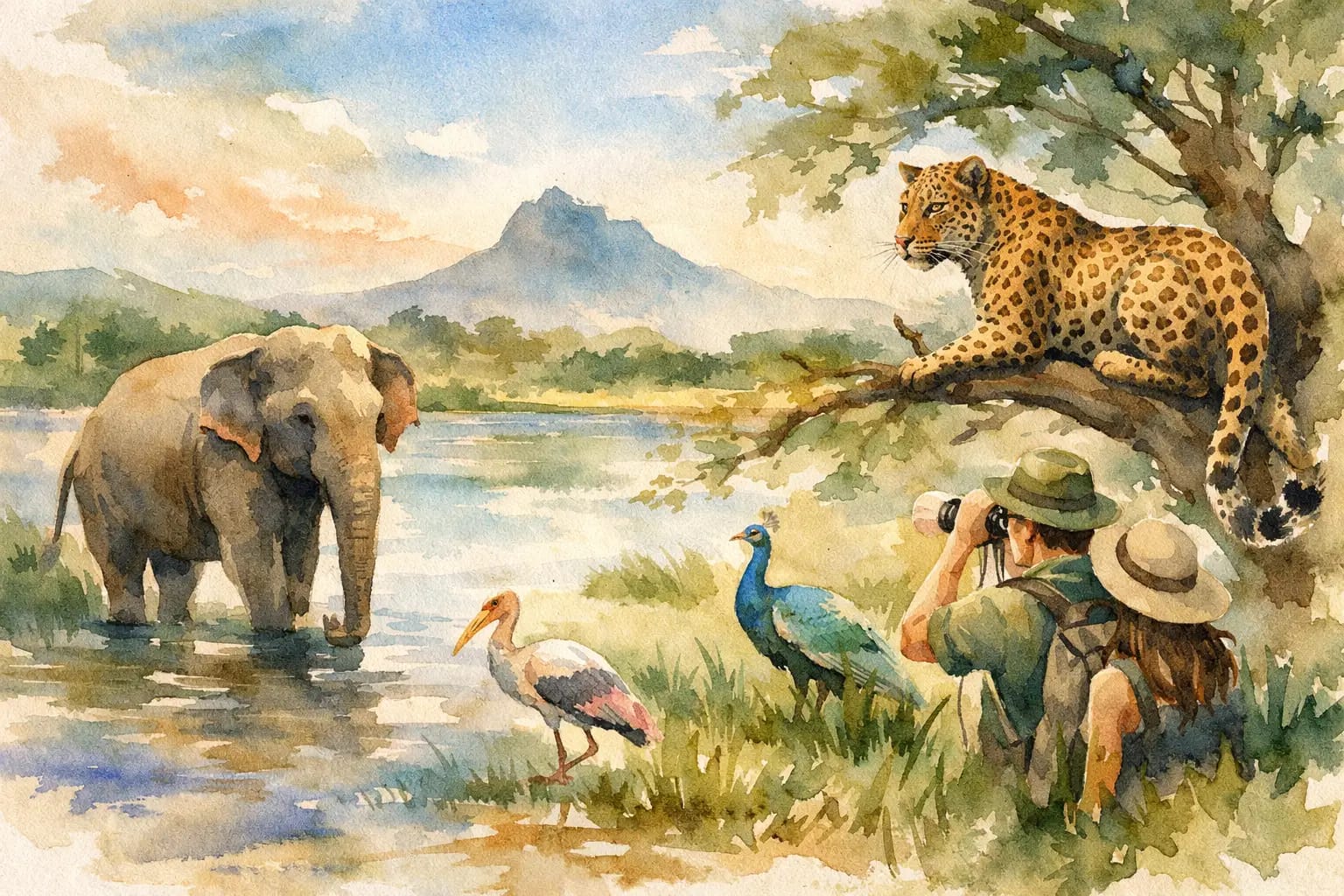
The hush before sunrise in Yala, the sudden silhouette of an elephant crossing an open plain, the deep blue horizon beyond Mirissa – these are moments that stay with you. Yet the most memorable wildlife experiences are rarely the loudest or closest. Responsible wildlife tourism Sri Lanka is about travelling with enough care, patience and expert insight to let the island’s extraordinary nature remain wild.
For a luxury holiday, that principle need not mean compromising on comfort. It means choosing private, well-paced journeys, thoughtful lodges and knowledgeable naturalists who place animal welfare and habitat protection ahead of a dramatic photograph. Done well, it creates a far richer encounter.
Why responsible wildlife tourism in Sri Lanka matters
Sri Lanka is remarkably biodiverse for an island of its size. Leopards move through dry-zone forest, Asian elephants gather beside ancient tanks, sloth bears forage for fruit and blue whales pass offshore. These habitats are also under pressure from development, climate change, vehicle congestion and the simple fact that wildlife viewing is popular.
Tourism can help protect these places when visitor income supports local employment, responsible accommodation and the value of conserving land. It can also cause harm when jeeps crowd an animal, boats pursue whales too closely or visitors treat wild creatures as props. The difference is often determined by choices made long before you enter a park: where you stay, who guides you and how your day is designed.
A considered itinerary allows time for the quieter side of nature. Rather than racing between every famous park, choose two contrasting landscapes and experience each properly. A few unhurried nights near a reserve can bring early departures, restorative afternoons by the pool and a return drive when the light softens – without asking wildlife to perform to a rushed schedule.
Choose the right wildlife experience, not just the famous one
Yala is celebrated for its leopard sightings, and rightly so. Its dramatic mix of scrubland, lagoons and coastline makes it one of Sri Lanka’s most compelling safari destinations. It is also busy at peak periods. A visit can still be exceptional, but the quality depends on entering at a considered time, using a respectful driver and accepting that a sighting is never guaranteed.
For a more secluded forest atmosphere, Wilpattu offers broad villus – natural lakes – and a strong sense of wilderness. It can suit travellers who are happy to exchange the likelihood of frequent sightings for a quieter, more immersive safari. Udawalawe is particularly rewarding for elephant viewing in open country, while Minneriya and neighbouring parks can be remarkable during the seasonal elephant gatherings. Which park is best depends on the month of travel, rainfall patterns and what you most hope to see.
This is where local planning matters. Wildlife does not follow a brochure timetable. A bespoke route can respond to the season, avoid needlessly long transfers and balance a safari with the tea country, Galle’s historic coast or a peaceful beach retreat.
Look beyond the headline species
A responsible guide will never make the day solely about a leopard, elephant or whale. They will point out the smaller details that reveal how an ecosystem works: painted storks in the wetlands, langur alarm calls in the canopy, crocodiles on a riverbank and the tracks left overnight in the dust.
This approach changes the mood of a safari. There is less pressure on the driver to chase a single sighting and more space for genuine interpretation. For families, it can be especially valuable, turning a game drive into an engaging lesson in observation rather than a tick-box hunt.
What a respectful safari looks like
The best safari guides read animal behaviour and keep a generous distance. If an elephant alters its route, raises its head repeatedly, flaps its ears or appears unsettled, the vehicle should retreat. If a leopard is resting, there is no need to edge closer for a sharper image. Good sightings happen when animals can behave normally.
Vehicle numbers matter too. In busy areas, a responsible driver will avoid joining a crowded cluster and may move on rather than add to the disturbance. This can feel like a trade-off in the moment, particularly if another jeep has found a sought-after animal. But it is the choice that protects the experience for the animal, and often leads to more meaningful observations elsewhere.
Keep voices low, remain in the vehicle unless instructed otherwise and never ask a guide to call, feed or lure wildlife. Flash photography should be avoided, particularly around nocturnal species. Drones are intrusive and are not appropriate in or around wildlife habitats without explicit permission.
Private safaris can be a more considered option than a packed vehicle, not because wildlife exists for exclusive access, but because a smaller party is quieter and your guide can set a pace around your interests. The essential point is that privacy must be paired with an ethical operator, not treated as permission to get closer.
Be discerning about elephants and captive animals
Sri Lanka’s elephants are magnificent, intelligent and socially complex. Seeing them in a national park, moving freely through their habitat, is profoundly different from riding, bathing with or posing beside a captive elephant. Any attraction that promises hands-on contact, performances or rides should be avoided.
Captive-animal facilities require particular care. Some may describe themselves as sanctuaries or conservation centres, but names alone do not demonstrate welfare. Ask whether breeding is encouraged, whether animals are restrained, whether visitors can touch them and whether the experience prioritises education over entertainment. Observation from a respectful distance is a far better standard than an encounter designed for social media.
The same principle applies to turtle hatcheries and other animal attractions along the coast. Conservation work can be valuable, but it should be transparent, scientifically informed and free from handling sessions for visitors. When in doubt, choose a wild encounter led by a trusted naturalist instead.
Whale watching needs patience and distance
The waters off Sri Lanka can offer remarkable whale and dolphin encounters, particularly from the south coast during the appropriate season. But a whale-watching trip should never resemble a chase. Too many boats, excessive speed and repeated approaches can disrupt feeding, resting and movement.
Choose a small, well-managed vessel that explains its approach before departure. The crew should slow down near animals, keep a respectful distance, limit viewing time and leave if wildlife changes direction to avoid the boat. Conditions at sea are variable, so an operator who cancels in rough weather or declines an unsafe approach is demonstrating good judgement, not providing lesser service.
For some travellers, a sunrise cruise is the ideal addition to a southern itinerary. For others, particularly those prone to seasickness or travelling with very young children, a coastal stay with dolphin-free horizons and time on the beach may be the more enjoyable choice. Responsible travel also means choosing experiences that suit you rather than forcing every highlight into one holiday.
Let your stay contribute to the landscape
Where you sleep has an effect on the places you visit. A lodge that employs locally, manages water carefully, reduces single-use plastic and works respectfully with neighbouring communities can make your stay part of a more positive visitor economy. Boutique properties near reserves often offer the added benefit of shorter journeys to the park, giving you a gentler start and less time on the road.
Ask whether the property has a meaningful relationship with its setting. This may be through habitat restoration, wildlife-friendly grounds, local guiding teams or practical support for nearby schools and communities. No hotel is impact-free, especially in fragile landscapes, but transparency and ongoing effort are worth seeking.
A well-designed journey also spreads value beyond park gates. Enjoying a locally prepared meal, purchasing crafts directly from makers and engaging guides from the region helps ensure that communities have a tangible stake in conserving the natural heritage visitors have come to admire.
Questions worth asking before you book
A carefully planned wildlife holiday should make ethical choices easy rather than leave you to investigate every detail on arrival. Before confirming an itinerary, ask your travel designer whether safari vehicles are private or shared, how they select guides and drivers, and whether they avoid wildlife-contact experiences. Ask about the seasonal suitability of each park, realistic transfer times and how many nights are needed to avoid a hurried visit.
It is also sensible to ask what happens if a safari is disappointing. The honest answer is that sightings cannot be promised. A thoughtful itinerary answers this not by making unrealistic claims, but by building in beautiful accommodation, excellent guiding and a rewarding range of landscapes, so the holiday never rests on one elusive animal.
At Lush Sri Lankan Holidays, a bespoke wildlife journey can be shaped around this slower, more respectful rhythm – pairing refined stays with experiences that honour the island’s living landscapes.
The privilege of seeing a wild elephant or leopard is not measured by how close you came. It is measured by the sense that, when your vehicle finally moved on, the animal was free to continue exactly as it had before.