


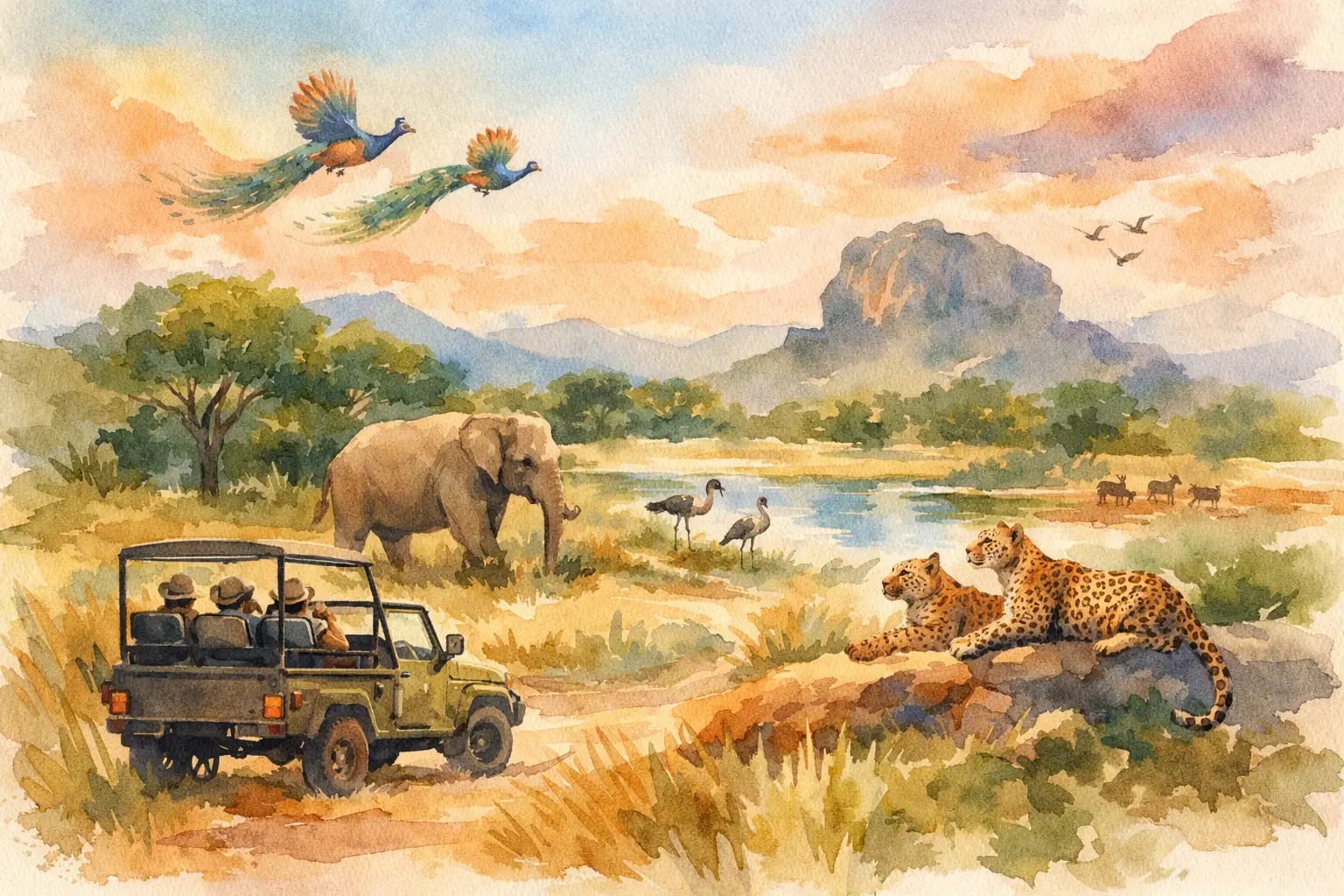
The first leopard sighting is rarely the moment guests remember most. It is often the stillness beforehand: a warm breeze moving through the scrub, the quiet concentration of an exceptional tracker, and the sense that the wild has set the pace. Knowing how to choose Sri Lanka safari is therefore about far more than selecting a national park. It is about creating the right rhythm, wildlife focus and level of comfort within your wider holiday.
Sri Lanka offers remarkable variety in a compact island. You may watch elephants crossing open grassland one day, search for a leopard beneath thorny jungle the next, then retire to a refined lodge or coastal hideaway. The best choice depends on when you travel, who you are travelling with and what you hope the safari will feel like.
Start with the wildlife you most want to see
A safari should be shaped around genuine interests rather than a checklist. Leopards are the natural draw for many first-time visitors, and Yala National Park is celebrated for its strong leopard population. Its dramatic mixture of dry forest, rocky outcrops, lagoons and coastline also makes every game drive visually memorable. The trade-off is popularity: during peak periods, some areas can feel busier than the private wilderness experience travellers imagine.
For a more spacious, quietly atmospheric alternative, consider Wilpattu National Park. Its signature villus – natural forest-fringed lakes – attract deer, birdlife, sloth bears and leopards, while the park’s scale lends a more exploratory feel. Sightings can be less predictable than in Yala, but that uncertainty is part of a true safari’s appeal. Wilpattu suits couples and return visitors who value unhurried drives and wild landscapes as much as a particular photograph.
If elephants are your priority, Udawalawe National Park is a superb choice. Its open terrain makes viewing easier, and elephant encounters are often wonderfully close while remaining respectful. Families particularly appreciate its accessible drives and reliable wildlife activity. Minneriya, Kaudulla and Hurulu Eco Park, in the Cultural Triangle, can be equally compelling at the right time of year, when seasonal elephant movements create extraordinary gatherings across the plains.
Birdwatchers should look beyond the headline parks. Kumana National Park is especially rewarding for wetlands and migratory birds, while Bundala brings lagoons, shorebirds and a gentler pace. Gal Oya offers a distinctive experience, including boat safaris where wildlife may be seen along the water’s edge. A bespoke itinerary can make room for these quieter parks without compromising the classic highlights.
How to choose Sri Lanka safari by season
Sri Lanka’s weather patterns are wonderfully nuanced. The island has more than one monsoon influence, so a well-timed safari can be paired with the Cultural Triangle, tea country or a beach stay even when another region is wetter. There is no single perfect month for every park.
Yala is often at its driest from roughly February to June, when water sources draw animals into more visible areas. Park closures sometimes take place in September or October for rest and regeneration, although dates can vary, so this should always be checked when planning. Udawalawe generally offers rewarding elephant viewing through much of the year, while Minneriya’s famous elephant gathering tends to be most likely between July and October. Rainfall and food availability influence animal movement, however, so nature does not work to a fixed calendar.
For a December holiday, a safari in the south-east may combine beautifully with the south coast, whereas an itinerary travelling through the north-west may be better suited to Wilpattu depending on current conditions. Your route should be designed as a whole, not assembled as separate overnight stops. A knowledgeable planner will consider weather, road times, park operations and the character of each lodge before recommending a safari.
Choose the experience, not simply the park
Two guests can visit the same national park and come away with entirely different memories. The difference often lies in the operator, vehicle and timing of the drive.
A private jeep allows more flexibility than a shared vehicle. You can pause for a crested serpent eagle, linger at a waterhole or return to camp when younger children are tired. It also creates a more personal experience for honeymooners and couples who would rather not follow another group’s schedule. Shared safaris can be sociable and cost-conscious, but they are less adaptable.
Early morning drives bring cool air, evocative light and often the best chance of seeing active wildlife. Afternoon drives have their own charm, especially as elephants emerge and the landscape softens towards sunset. For a two-night safari stay, one drive in each time slot provides a balanced perspective without making the holiday feel rushed.
Guide quality matters enormously. The finest naturalists do not promise sightings. Instead, they read tracks, alarm calls, wind direction and the smallest movement in the undergrowth, while helping guests understand the ecology around them. Ask whether your safari includes an experienced local tracker or naturalist, not simply a driver. Their insight turns a lucky encounter into a meaningful one.
Match your lodge to your idea of luxury
Safari accommodation in Sri Lanka ranges from polished boutique hotels near park gates to tented camps that place you closer to the sounds of the bush. Neither is automatically better. The right choice depends on whether you want immersion, indulgence or a considered balance of both.
A tented camp can feel wonderfully romantic: lantern-lit dinners, night sounds beyond the canvas and the anticipation of a dawn departure. Yet those seeking generous suites, a swimming pool and a more extensive dining experience may prefer a boutique lodge nearby. Families may value interconnecting rooms, flexible mealtimes and a pool after a dusty drive. Couples may place privacy, outdoor bathing and a secluded setting higher on the list.
Think carefully about the length of stay, too. One night is possible, but it can feel compressed after a long transfer. Two nights usually allow time to settle in, enjoy two or three drives and appreciate the property itself. Three nights are particularly worthwhile for keen photographers, birders or travellers choosing a more remote park such as Wilpattu or Gal Oya.
Build in comfort and realistic travel times
Sri Lanka may look small on a map, but road journeys can be slower than expected. A safari added between Sigiriya and the southern coast is possible, though it needs thoughtful pacing. Trying to reach a park, complete an afternoon game drive and check into a lodge after a lengthy transfer can turn an anticipated highlight into an exhausting day.
A better approach is to give the safari its own breathing space. Arrive in time for a relaxed lunch or afternoon by the pool, then set out when the heat begins to ease. Afterwards, continue to the coast or hill country the following morning. Private chauffeur-guided travel is particularly valuable here: luggage, timings and stops are handled with calm precision, leaving you free to enjoy the changing scenery.
For families, shorter drives and a lodge close to the park entrance can make all the difference. For honeymooners, a night or two in a characterful camp between cultural touring and beach relaxation creates a thrilling change of scene. Solo travellers may prefer a lodge with communal areas and an engaging naturalist-led programme. There is no one-size-fits-all safari, even within the same park.
Put ethical wildlife viewing first
The most luxurious safari is one that respects the animals and the places they inhabit. Choose partners that keep a responsible distance, avoid crowding animals and do not encourage guides to chase sightings. A leopard resting in shade, viewed quietly for a few minutes, is more special than a stressful encounter staged for a camera.
It is also worth managing expectations. Sri Lanka has exceptional wildlife, but it is not a zoo. You may see a leopard within minutes or not at all. The reward lies in paying attention to everything else: langurs calling from the canopy, crocodiles slipping through still water, painted storks lifting from a lagoon and the immense presence of an elephant herd moving through dust-gold light.
Photography should follow the same principle. Leave flash off, keep voices low and let your guide decide when it is appropriate to move on. The photographs will carry more meaning when the encounter has been allowed to unfold naturally.
Let the safari elevate the whole holiday
A safari is at its most powerful when it forms part of a wider Sri Lankan story. Pair elephant country with the ancient cities of the Cultural Triangle, or follow Yala with slow days on the south coast. Add tea-covered hills, a restorative spa ritual or a few nights in the Maldives if your dream escape calls for both wilderness and water.
At Lush Sri Lankan Holidays, this is where tailored planning becomes especially valuable: matching the right park and lodge to your dates, then weaving it into a journey that feels effortless from arrival to departure. Leave room for the unexpected, because the finest safari moment may be the one no itinerary could promise.