


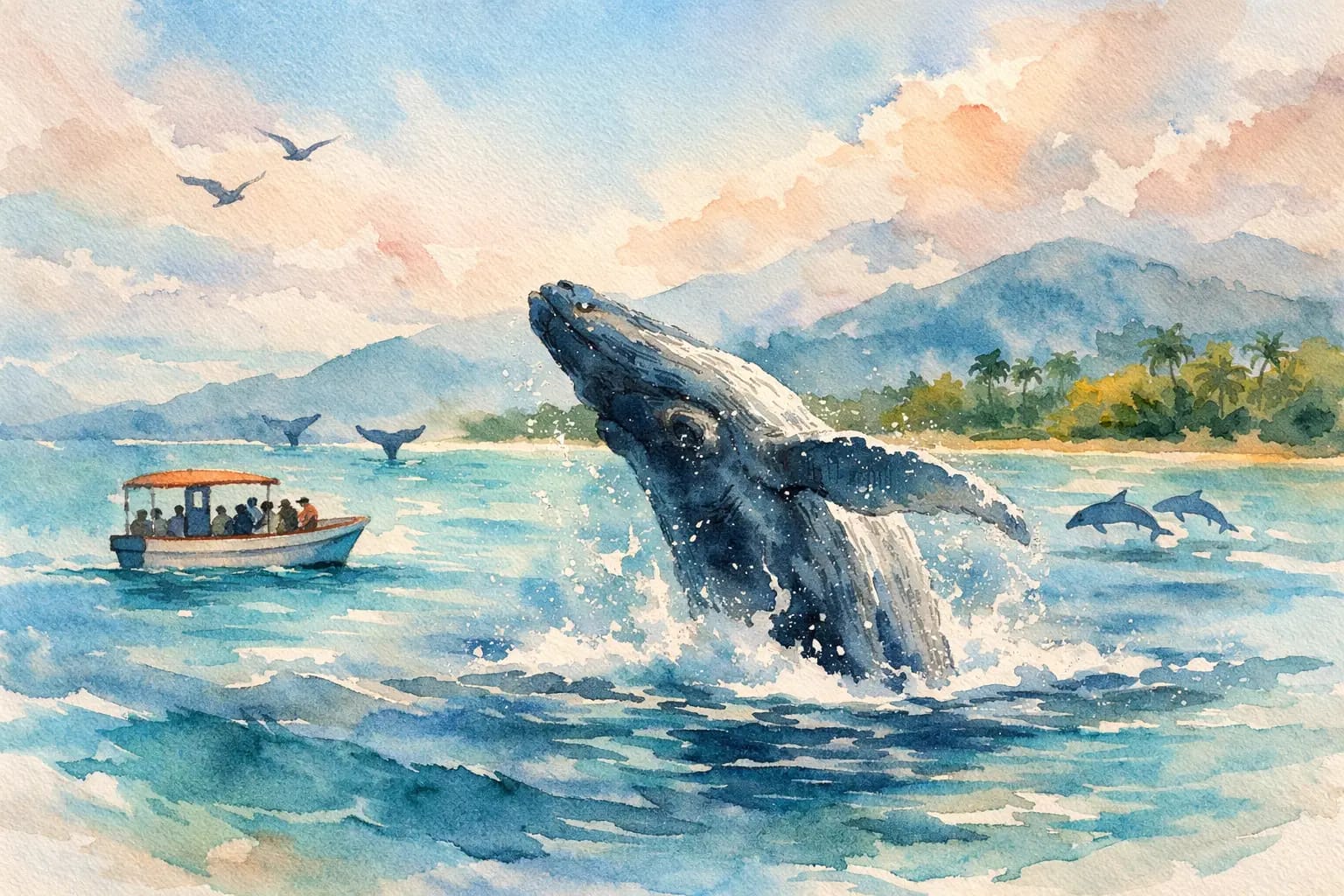
A blue whale can be longer than the boats that set out to find it, yet its first appearance may be no more than a quiet plume on a wide, cobalt horizon. The best Sri Lanka whale watching is not simply a boat trip added to an itinerary. Timed well, it is one of the island’s most affecting wildlife encounters – a morning of anticipation, salt air and the extraordinary privilege of seeing the world’s largest animal in its natural waters.
Sri Lanka is one of the few places where blue whales can be seen relatively close to shore, particularly along its southern coastline. But a rewarding experience relies on more than choosing a date online. The right coast, sea conditions, boat standard and a respectful operator all shape the day. For a beautifully paced holiday, whale watching works best as part of a considered coastal stay, leaving room for rest should the weather shift.
Where is the best Sri Lanka whale watching?
For most first-time visitors, Mirissa is the leading choice. Its position on the south coast places it near deep ocean waters where blue whales, sperm whales and several dolphin species are regularly encountered during the main season. It is also exceptionally easy to pair with a few unhurried nights at a refined beach retreat, or with the characterful lanes and fort walls of Galle.
Mirissa: the classic blue whale experience
Mirissa is at its strongest from November to April, when the south-west coast is generally calmer and sea conditions are more favourable. Early morning departures are customary, often leaving before sunrise, when the coast is still quiet and the light is soft across the Indian Ocean.
Blue whales are the great draw, although they remain wild animals following their own patterns. Sightings are never guaranteed, and any operator who promises otherwise should be approached with care. On a good morning, guests may also see sperm whales, spinner dolphins, flying fish and, occasionally, sea turtles.
The trade-off is popularity. Mirissa has become well known, so busy days can bring many vessels into the same area. A carefully selected small-group or private charter offers a more composed experience, with better space on deck, attentive crew and less of the feeling that the encounter is being chased. For honeymooners, families with older children and travellers seeking a polished southern Sri Lanka itinerary, this is usually the most convenient option.
Trincomalee: a quieter east-coast alternative
From roughly May to October, attention turns to Trincomalee on Sri Lanka’s east coast. As monsoon conditions affect the south and west, the sea off Trincomalee is typically calmer. The region offers the chance to look for blue whales and sperm whales while enjoying a markedly different rhythm from the south.
Trincomalee is a particularly appealing choice for guests travelling in the British summer holidays or those who prefer an itinerary that feels a little more secluded. Nilaveli’s pale sands, Pigeon Island’s clear waters and the area’s historic harbour make it possible to combine marine wildlife with slow beach days and snorkelling.
It does, however, require more purposeful routing. If your holiday is centred on Colombo, Kandy and the south coast, adding Trincomalee can mean longer road journeys or a domestic flight arrangement. It is worth it for those with sufficient time, but not always the best fit for a shorter, one-week escape.
What about Kalpitiya?
Kalpitiya, on the north-west coast, is better known for dolphins than reliable blue whale viewing. Its large spinner dolphin gatherings can be spectacular, and its lagoons and wide beaches have a quieter, more elemental appeal. For guests whose main wish is to see whales, Mirissa or Trincomalee remains the stronger choice. For those drawn to a broader marine wildlife day, Kalpitiya can be a delightful addition to a tailor-made route.
When to plan your whale watching cruise
The simplest rule is to match your coast to the season. Plan Mirissa between November and April, and look to Trincomalee between May and October. These windows reflect the island’s two monsoon systems and are a helpful guide rather than a rigid promise. Ocean conditions can change quickly, even during the preferred months.
For the calmest, most enjoyable outing, place your cruise early in your beach stay rather than on the final morning. If high winds or swells lead to a cancellation, you will have another opportunity to go. This small piece of itinerary planning makes a meaningful difference, especially where a whale encounter is a highlight of the journey.
Morning cruises are generally preferable. The sea is often calmer, wildlife activity can be excellent, and you return with the afternoon free for a poolside lunch, an Ayurvedic treatment or a sunset walk along the shore. Guests prone to motion sickness should speak to a pharmacist before travelling and choose a larger, stable vessel where possible.
Choosing a responsible whale watching experience
A close approach is not necessarily a better one. The most memorable sighting often happens at a respectful distance: a whale surfacing steadily, its vast back catching the light before its tail slips beneath the water. Responsible wildlife viewing protects that experience for future travellers and, more importantly, reduces disturbance to the animals.
Look for a crew that keeps a sensible distance, limits the time spent with each animal and avoids crowding or cutting across a whale’s path. Captains should slow down when wildlife is nearby and be willing to move on if other boats have already gathered. A responsible operator will also give a clear safety briefing, provide life jackets and communicate honestly about sea conditions.
Comfort matters too, particularly for a premium holiday. Shade, clean seating, drinking water and a well-maintained washroom can transform an early start into a genuinely pleasurable morning. Private charters offer the greatest flexibility, although they are not essential for everyone. A thoughtfully run small-group cruise is often ideal for couples and families who want quality without the cost of exclusive use.
How to weave whale watching into a luxury Sri Lanka holiday
On the south coast, allow three nights around Mirissa, Weligama or Tangalle. This provides enough breathing space for the cruise, a relaxed day by the sea and time to enjoy the region beyond the harbour. The drive from Galle is straightforward, while travellers coming from Yala can continue westward after a safari, creating an exceptional wildlife pairing: elephants and leopards on land, then whales offshore.
For an east-coast itinerary, Trincomalee sits beautifully after the Cultural Triangle. After visiting Sigiriya, Dambulla and perhaps Kandy, a few nights in Nilaveli offer a refreshing change of pace. The journey is part of the pleasure when it is well arranged, with a private chauffeur-guide, considered stops and accommodation selected for its setting rather than simply its star rating.
Families should consider the length of the cruise and their children’s confidence at sea. Young children may find a three- to five-hour outing demanding, even when whales appear. Couples may prefer a private sunrise departure followed by breakfast back at their hotel. Solo travellers often enjoy a small-group boat, where a knowledgeable naturalist adds welcome context without making the experience feel over-scripted.
What to take, and what to leave to chance
Bring sun protection, a light cover-up, sunglasses with a secure strap and a camera or phone protected from spray. Wear soft-soled shoes that are easy to remove, and keep expectations open. The ocean does not perform to a timetable, which is precisely why a sighting feels so significant.
A skilled guide can help you understand what you are seeing – the difference between a blue whale’s low, broad blow and the more angled spout of a sperm whale, or why dolphins sometimes gather around feeding activity. Yet silence has its place too. When a whale surfaces beside an open horizon, there is little need to fill the moment.
At Lush Sri Lankan Holidays, we can shape whale watching around the season, your preferred style of accommodation and the pace you want from the rest of your escape. The finest itineraries leave space for such moments: an early boat ride, an unexpected breach in the distance, and the deeply satisfying return to shore with the day still ahead of you.