


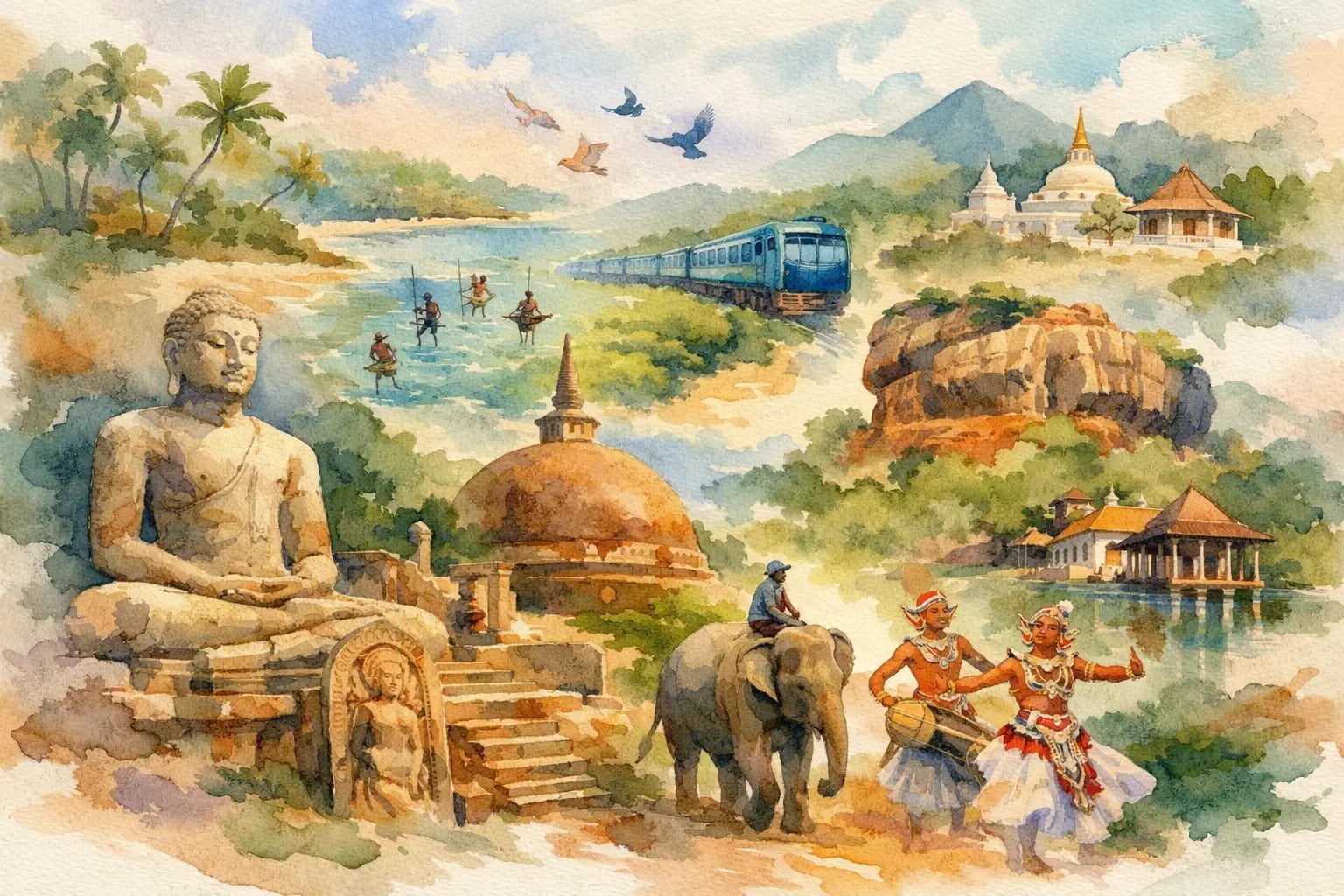
Some itineraries ask too much of Sri Lanka. They rush from temple to fortress to national park, leaving little room to absorb what makes the island so affecting in the first place. A well-crafted Sri Lanka cultural tour itinerary should feel different – beautifully paced, rich in heritage, and comfortable enough that each day still feels like a holiday.
For travellers who want more than a checklist of famous sites, the most rewarding route is one that lingers in the Cultural Triangle, then unfolds gently towards Kandy and the hill country. This allows space for private guiding, memorable stays, and those quieter moments that often become the most vivid: monks in white at a shrine, the scent of frangipani after rain, a late afternoon view over jungle-covered plains.
Why this Sri Lanka cultural tour itinerary works
Sri Lanka’s cultural highlights are not all clustered in one easy-to-walk district. Ancient capitals, cave temples, sacred relics and colonial-era cities are spread across several regions, each with its own rhythm. That means the best itinerary is not simply about fitting in the major names. It is about sequencing them well.
Starting in the Cultural Triangle keeps early travel times manageable after arrival and places you close to several UNESCO-listed treasures. From there, moving on to Kandy makes sense both geographically and emotionally. The journey builds from archaeological grandeur to living spiritual tradition, then softens into the cooler, greener landscapes of the hills.
For most luxury travellers, 10 days is a very comfortable minimum for a culture-led journey. A week can work, but it requires tighter routing and less downtime. Twelve to fourteen days gives you the freedom to combine cultural touring with a beach stay or a few nights focused on wellness.
A 10-day Sri Lanka cultural tour itinerary
Days 1-2: Arrival and transfer to the Cultural Triangle
After landing, the most pleasant beginning is a direct transfer to a refined hotel in the Cultural Triangle, often near Sigiriya, Habarana or Dambulla. Rather than staying in Colombo after a long-haul flight, many travellers prefer to settle straight into a peaceful resort surrounded by tropical gardens and lakes.
These first two days should be deliberately gentle. Depending on your arrival time, you might enjoy a leisurely lunch, a spa treatment, or a quiet evening by the pool before touring begins in earnest. This softer start makes a real difference, especially if you are arriving from the UK and adjusting to the heat and time difference.
On the second day, Dambulla Cave Temple is an excellent introduction. The complex is visually striking but also deeply atmospheric, with ancient Buddhist murals and serene golden statues set within rock caves. It is best visited with a knowledgeable guide who can bring context to what you are seeing, rather than leaving the experience as simply photogenic.
Day 3: Sigiriya or Pidurangala, then village life
Sigiriya is one of Sri Lanka’s defining landmarks, and rightly so. Rising dramatically from the plains, this ancient rock fortress offers a fascinating blend of royal ambition, engineering, art and landscape design. Arriving early is wise, both for the cooler temperatures and the softer light.
Not every traveller wants the full climb, however, and that is where good planning matters. Some prefer to admire Sigiriya from a distance and choose Pidurangala for a slightly different perspective. Others are happy to tackle the ascent but benefit from a slower afternoon afterwards. The trade-off is simple: more physical exertion brings spectacular views, while a gentler approach leaves more energy for the rest of the journey.
Later in the day, a more intimate local experience can balance the grandeur of the morning. A village visit, traditional cookery session or catamaran ride on a reservoir gives the day warmth and texture without feeling staged when arranged thoughtfully.
Day 4: Polonnaruwa and the island’s ancient sophistication
Polonnaruwa rewards travellers who enjoy history with depth and elegance. The ruins are expansive, beautifully preserved in parts, and reveal an extraordinary level of medieval urban planning. Palaces, bathing pools, image houses and monumental Buddha statues all speak to a civilisation that was both sophisticated and deeply spiritual.
This is one of those places where the quality of guiding shapes the experience. With the right storyteller, the stones regain their purpose and drama. Without that, it can feel like a hot archaeological site with lovely ruins. For luxury travellers, travelling by private vehicle and choosing the right time of day turns a potentially tiring excursion into a deeply enjoyable one.
Day 5: Anuradhapura or a slower day at leisure
By day five, preferences tend to split. Travellers with a strong interest in Buddhist heritage often choose Anuradhapura, another ancient capital with immense religious significance. Its stupas, monastic compounds and sacred Bodhi tree lend the day a ceremonial quality that many find profoundly moving.
Others may prefer not to include both Polonnaruwa and Anuradhapura in a 10-day journey. That is a sensible choice, not a missed opportunity. The sites are both remarkable, but cultural travel should still leave room to breathe. A slower day at the hotel, perhaps with an ayurvedic treatment or a sunset wildlife drive in Minneriya depending on the season, can keep the itinerary feeling indulgent rather than demanding.
From the Cultural Triangle to Kandy
Day 6: Matale and arrival in Kandy
The drive south towards Kandy naturally lends itself to a few carefully chosen stops. A spice garden in Matale can be worthwhile if done well, especially for travellers interested in Sri Lanka’s culinary and botanical traditions, though experiences vary and some feel more commercial than others. This is where curated planning matters.
Kandy has a different energy from the ancient cities. It is busier, greener and more immediate, with its lake, hills and sacred sites woven into daily life. Checking into a gracious hotel overlooking the city or tucked into the surrounding hills gives you the chance to enjoy Kandy from a calmer vantage point.
Day 7: Temple of the Tooth and Kandy’s living culture
The Temple of the Sacred Tooth Relic is not simply a historic monument. It remains one of the most important living religious sites in the country, and that distinction changes the atmosphere entirely. Visiting with sensitivity, ideally at a quieter hour, allows you to witness devotion rather than just architecture.
Kandy is also a good place to encounter Sri Lanka’s cultural traditions in performance and craft. A private city tour might include local markets, a gem museum, or a more carefully selected cultural performance in the evening. Some travellers enjoy the pageantry; others prefer quieter experiences. The best itineraries are tailored accordingly.
Extending the cultural journey into the hills
Days 8-9: Tea country and colonial-era heritage
A cultural itinerary need not stop at temples and ruins. Sri Lanka’s hill country adds another layer, shaped by tea, railways, plantations and colonial architecture. Moving on to Hatton or Nuwara Eliya shifts the mood of the trip in the loveliest way. The air cools, the roads curve through emerald slopes, and the pace slows again.
This part of the journey is especially appealing for couples and honeymooners who want heritage with softness around the edges. You might visit a tea estate, learn about the island’s plantation story, and spend the rest of the afternoon on a terrace with mountain views. It is culture, certainly, but interpreted through landscape, design and the rituals of hospitality.
Day 10: Return or continue to the coast
From the hills, you can return for your flight home or continue to the south coast for a few restorative nights by the sea. That final choice depends on the kind of holiday you want. If the journey has been primarily about heritage and discovery, ending by the beach brings a welcome exhale. If time is limited, a direct departure may be the better fit.
How to tailor a Sri Lanka cultural tour itinerary for comfort
The difference between a pleasant cultural trip and an exceptional one often comes down to pacing, hotel selection and transport. Sri Lanka’s roads can be slow, and distances that look modest on a map may take longer than expected. Splitting stays intelligently is far more comfortable than trying to cover too much ground from one base.
Accommodation also matters more than many travellers realise. After a morning of temple visits or site walks in tropical heat, returning to a beautiful room, attentive service and a shaded pool changes the entire feel of the holiday. Boutique properties and heritage hotels often complement a cultural route especially well, adding character rather than simply convenience.
Private guiding is another worthwhile refinement. It creates flexibility, allows you to move at your own pace, and adds nuance to each destination. For those planning a bespoke trip with a specialist such as Lush Sri Lankan Holidays, this is often where the journey becomes more personal and far less generic.
When to go
Sri Lanka can be visited year-round, but the ideal timing for a cultural itinerary often falls between December and April for many long-haul travellers, particularly those combining the Cultural Triangle with Kandy and the south or west coast. July and August can also be excellent for culture-focused travel, especially if you are interested in Kandy’s festive season, though demand is higher and early planning is wise.
Shoulder periods can be attractive too. Landscapes are lush, sites may feel quieter, and hotel value can be stronger. The trade-off, naturally, is a greater chance of rain, but showers are often brief rather than trip-defining.
A beautifully planned cultural journey through Sri Lanka should leave you enriched, not exhausted. When the route is balanced with care, the island reveals itself in layers – ancient, spiritual, elegant and unexpectedly intimate – and that is when the holiday truly stays with you.